Introduction
October 7 and the war that followed must be understood through the history of colonial domination, the class forces contesting it, and the political tasks confronting us in the heart of empire. We begin with that history and the conditions in Gaza before October 7. We then examine the communist movement’s disagreements through the PFLP’s conception of the struggle. Finally, we ask what it means to understand this rupture as an event, and what organization is required to carry a commitment to liberation through the winter of capitalist imperialism.
The history of October 7th
Marx tells us to be ruthless critics of our time, neither afraid of the conclusions nor the powers that sustain the state of things. Mocking the maudlin Englishman’s response to the Indian revolts, Marx deconstructed their framing of the history of colonialism. For Marx the insurgents’ actions are but a reflex of England’s rule, where torture “formed an organic institution of its financial policy.” His comparison with British atrocities in China exposed a colonial habit: the conqueror’s violence becomes the growing pains of a modern government, while the colonized person’s violence becomes the unacceptable behaviour of a people in need of civilizing.[1] It might seem ridiculous but such is the habit of any left that begins its account of Palestine on October 7.
Engels’s Persia—China examined the asymmetrical popular resistance facing the West.[2] Lenin’s The War in China asked who benefited from conquest and who paid for it: capitalists gained opportunities while working families bore taxation, deprivation and the loss of their fathers and sons.[3] This wisdom was not only held by Marxists since even Mark Twain knew this distinction with clarity with his famous quote: “what is the horror of swift death by the axe, compared with lifelong death from hunger, cold, insult, cruelty, and heart-break?”[4] Terror might seem explosive, but appearances cover a sea of troubles that had led to it. Violence appears peaceful when it has become routine.
Contrary to the puritanical sectarians of our time, Lenin, never the dogmatist, assessed a movement by its social roots, and its relations to the imperialist system globally. Defending the Irish rebellion, he wrote: “Whoever expects a ‘pure’ social revolution will never live to see it.”[5] To grasp the historical foundations of any movement, any resistance or any organization we must probe into its history, mainly the history of its class struggle.
The Palestinian struggle against capitalist imperialism is often set in the mid-1930s. The most famous would be the uprising of Al-Qassam, whose organizing preceded the 1936–39 revolt. The uprising faced contradictions best described by Kanafani, who traced it through the class struggle of workers and peasants as they faced their own inept Arab ruling classes and colonial powers.[6] Almost all that followed rehearsed these events: peasants rose against their upper classes, who were willing to concede to the Israeli occupation. This forced even bourgeois and petit-bourgeois elements in Palestinian civil society into a unified front against the occupation, laying the groundwork for their eventual betrayal. The Nakba, the occupation of 1967 and the subsequent Intifadas mark different stages of that struggle. These were the stages that lay beneath the scenery of what we know as the events of October 7th.
To refresh the minds of the forgetful: Gaza had been under siege with a heavy blockade since 2007. Palestinian life was marked by an almost ceaseless daily reminder of the occupation whether restrictions on movement, trade or access to medicine or doctors. Deprivation was and remains a perpetual condition of life.[7] A near century of unceasing murder glossed over this whole canvas of the Palestinian tragedy. Human-rights organizations recorded 234 Palestinians killed by Israeli forces or settlers in the occupied territory from January through September 2023 alone, 45 of whom were children.[8] The Great March of Return (2018-2019), an initiative of Palestinian civil rights activists, saw the slaughter of 214 Palestinians, including 46 children. What is left to a people, who in their non-violent activism are faced with machine gun fire and snipers? What is the response of an ethical consciousness to the shooting of children? Even the ideological apparatuses of the American global order like the OCHA described the vast majority of protesters as peaceful.[9] Such were the material and human conditions of the impending rupture. Maybe for an ostrich living in the desert of the imperial west these facts can be forgotten. But how long do a people under fire wait for this ostrich to finally lift its head and grow a conscience? Why wait at all, when the West sees the worth of the Palestinians, the Iraqis, the Yemenis, the Congolese and all the bodies that look nothing like the Western man as worth only death and destitution? What is ethics without a people to defend it, without its warriors to defeat its enemies?
On October 7th, Hamas and other Palestinian armed commandos, the elite units of all that had congealed over years under siege, attacked the so-called impenetrable colonial fortress, known as Israel. The UN commission condemned the prisoners of Gaza for escaping their captivity and having the tenacity to no longer be victims but fight back against the society that was celebrating outside of their prison walls. Were the British civilians of the Raj, the French in colonial Haiti, or the German civilians taking over former Jewish homes and the eastern lands for their own Lebensraum merely civilians? What was the duty of the Soviet army as it met the German civilians after seeing the camps, after seeing their country devoured for a racist project? The UN promises civilian protection no matter the complicity of those same civilians in crimes of their state. These laid the groundwork for documenting civilian casualties during the operation.[10] Yet as time passed, the truth has a way of finding those willing to listen. The made-up stories about beheaded babies and babies in microwaves turned out to be part of the quintessentially Israeli policy of the Hannibal directive. Israel’s Hannibal Directive prioritized preventing soldiers’ capture through military force even at the risk of killing captured soldiers and civilians. Israeli news outlets like Haaretz documented its use in at least three military facilities on October 7.[11] It was evident: civilian deaths are condemnable only if they are committed by Palestinians fighting for freedom. There are the bodies whose death is sanctioned by the necessities of war, like the countless dead in Gaza, and those whose death (despite who has killed them) justifies a genocide[12] funded by the American taxpayer.[13]
The arrival of the communist moment
The PFLP’s Strategy for the Liberation of Palestine centers its analysis of alliances through the question of enemies and friends. Its class argument is explicit: “Workers and peasants are the mainstay of the revolution.” The inhabitants of camps and poor urban districts are their social base; their interests cannot be entrusted indiscriminately to Palestinian capitalists or reactionary Arab governments. The text recognizes the necessity of alliances no matter what contradictions they may engender but warns that bourgeois interests can divert the struggle from its objectives.[14] To take this conception seriously today is to examine where leadership is rooted and upon whom it depends.
A case in point would be the communist responses to the 1973 war. In China, on October 8 People’s Daily commentary expressed firm support for Egypt and Syria; Peking Review reproduced it four days later.[15] Cheng Kung’s October 26 article presented the Palestinian guerrillas and Arab oil measures as connected dimensions of an anti-imperialist struggle.[16] Cuba’s Raúl Roa told the UN General Assembly on October 10: “The cause of the Arab peoples is our cause.”[17] For these interventions, Palestine belonged to a struggle whose consequences extended beyond the region. In these words it is clear who their friends were.
After the de-escalation of hostilities Habash, the then General Secretary of the PFLP, sharpened the demarcation line with a simple question: land had been recovered, “but at what price?” His 1974 interview argued that US influence was being restored while Arab governments relinquished military pressure and lifted the oil embargo against imperialist countries.[18] Rakah, The Communist Party of Israel, in their From Ceasefire to Peace took an opposite course, calling for the withdrawal of Israeli forces from the territories occupied in 1967 while recognizing Israel’s sovereign existence.[19] The disagreement concerns the political order that a settlement would preserve and more importantly the fate of the forces capable of continuing the struggle against the enemy. What does peace mean when it is but a different word for the imposition of dependence and occupation?
Here lies the crux of the matter. A leadership can speak in the name of its people while becoming dependent on the class of people who stand against the fundamental interests of the people. An alliance can provide resources while establishing new limits. We must ask who sets those limits, who pays their cost, and whether workers and the oppressed retain the organizational capacity to fight them.
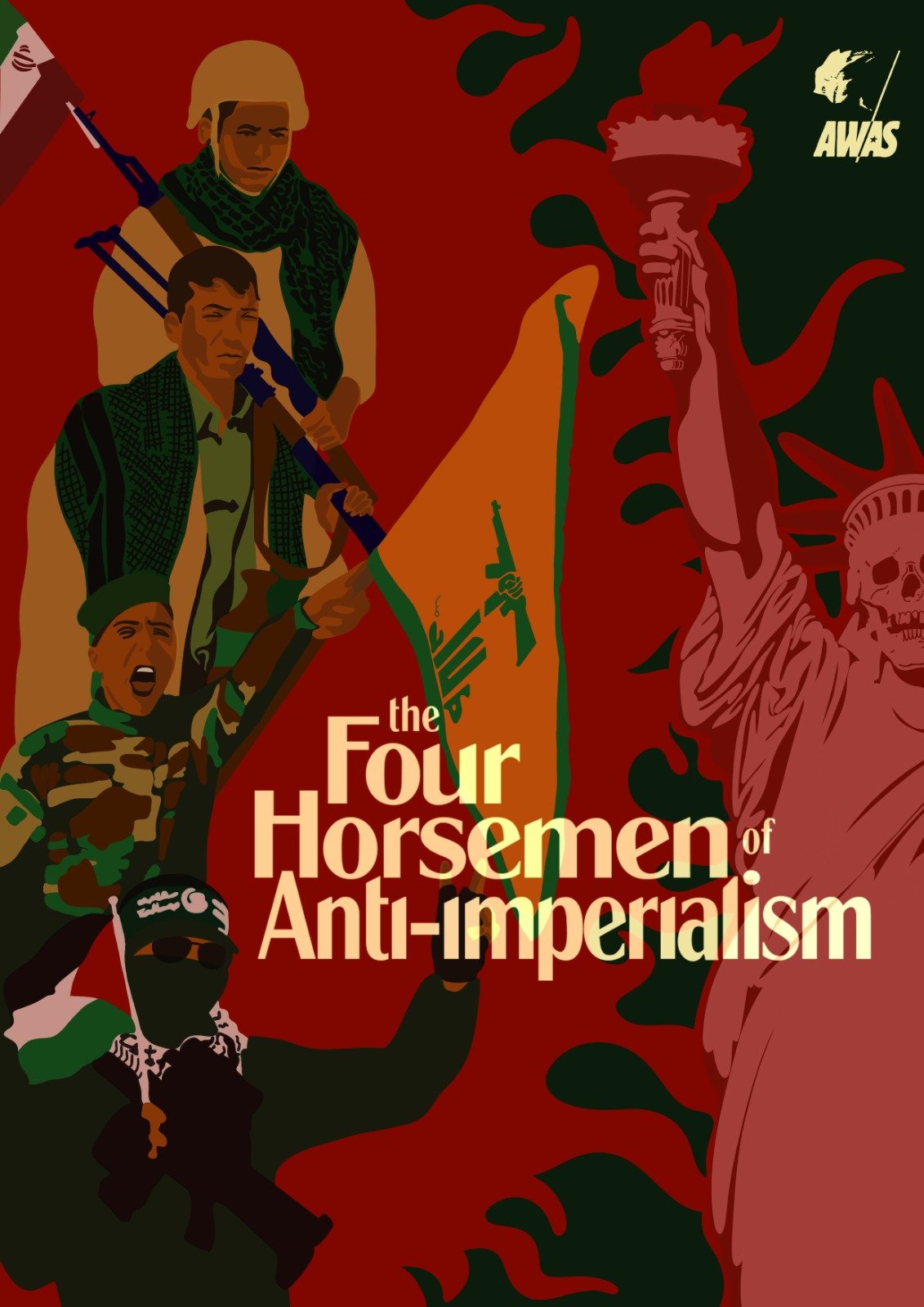
Today these forces have a large measure of independence, since the regional alignment includes Iran, Hezbollah, Hamas, Ansar Allah and Iraqi armed organizations, alongside Palestinian factions with different political programs. Iranian support connects these forces across the region.[20] The UN commission records coordination among Palestinian armed guerrillas, including Islamist and left organizations.[21] For the enemy, the horsemen galloping to flank their ranks are tightening their formations. Class analysis must understand the relations among these organizations, examined through their social bases, their relation to their people and their capacity to fight imperialism. A riding party has one enemy, and it is the enemy of the people in the camps. The war has far outstretched religious or even secular differences. The line on the sand is clear. Those who stand against imperialism and those who stand with it.
For example, one can point to Hezbollah’s social institutions as integral to understanding its political power. As Melani Cammett demonstrates, Hezbollah’s provision of healthcare, education, and welfare is closely connected to its political organization, garnering popular support, and a mass base in Lebanon.[22] It is not a surprise to find Hezbollah builds and maintains relationships with the communities it serves. The point is not that providing social services makes Hezbollah socialist, but that its relationship with the masses cannot be understood through its religious ideology alone. The Lebanese Communist Party, for example, has publicly supported Palestinian resistance (including Hezbollah) and opposed Israeli attacks on Lebanon.[23] This illustrates an important distinction: communists can support struggles against imperialism without necessarily sharing the ideology or political programme of every organization participating in them. Islamic resistance movements must therefore be assessed in relation to their concrete political role, and to be understood dialectically. Just as Izzeddin al-Qassam’s struggle against colonial occupation distinguished him from the conservative and collaborationist forces, so too is Hezbollah nothing like its enemy Daesh (ISIS), which enjoyed medical treatment from Israel, during the war in Syria.[24]
That is also why Lenin’s theses on the national and colonial questions make clear that communists should not make socialism a precondition for supporting struggles against imperialism.[25]. Lenin distinguished between bourgeois national liberation movements that genuinely struggle against imperialist domination and reformist bourgeois movements that accommodate or collaborate with imperialism. Lenin recognized that the material conditions of oppressed nations often made the emergence of socialist movements almost impossible and argued that it would be utopian to demand that national liberation struggles already be socialist. He called on communists to support genuinely revolutionary movements against imperialism, while distinguishing them from reformist, and most importantly comprador bourgeois, forces that collaborated with imperialism. It goes without saying that for communists in imperialist countries, the task is to support these struggles while confronting the imperialism of their own states.
October 7 as an event
To speak of October 7 as an event is to advance an argument about the political rupture and the process opened around it. In Badiou’s terms, the event and fidelity to it are distinct: the break is followed by decisions through which a subject attempts to sustain its consequences.[26] The event is not simply another name for the entire war. Nor does naming it settle its political truth. We have to ask what becomes possible, which subjects emerge, and whether their practice changes the relations that previously appeared impossible.
Undoubtedly, when it comes to Palestine, public attitudes have shifted. For example, a Pew survey in March 2026 found that 60 percent of US adults viewed Israel unfavorably, compared with 42 percent in 2022.[27] This does not mean a revolutionary subject has already emerged. Disillusionment can remain passive and become another electoral calculation, but it can also signal the beginning of a lasting organizational period. The passage from recognition to collective power is a political task. It is not an automatic consequence of suffering or a favorable opinion poll.
Badiou’s faithful, reactive and obscurantist subjects frame our present situation.[28] Fidelity to Palestinian liberation must be assessed through a prudent practice directed against the main enemy, imperialism, and must not to attach itself to liberal sentimentalism. A ceasefire is an urgent demand. The real concern is to wage war on the causes of the war. Oslo’s security arrangements provide a concrete example of recognition coexisting with continuing Israeli dominance and colonial occupation.[29] It is the reactionary subject that wants to pretend nothing happened on October 7th and simply go back to the way things were, a ceasefire to end the resistance. Seeking to return the open confrontation to the realm of legal and international institutions. For the obscurantist, Palestinians deserve compassion insofar as they remain innocent victims. When they organize themselves into a force capable of challenging the existing order, they become enemies of civilization. Their suffering demands charity; their political power demands a firm hand. The West and its global order override any claim they make to emancipation.
The ideological struggle must recognize how apparatuses and media outlets distinguish between the pitiable bodies of innocent victims and the “evil” resistance fighters they blame for those victims’ suffering, all to normalize Israeli violence and terror. Fanon’s account of colonial society directs us toward the spatial and material organization of domination.[30] In Gaza before October 7, this meant restricted movement, deprivation and control over the conditions of ordinary life. One only has to forget the continual siege and occupation of Palestinian lands to accept the Western narrative that this is just the way Palestinians behave. Symbolic violence matters because language can naturalize those relations, conceal their authors and decide who has the right to resistance and defense, and who must only remain a victim; otherwise, they are monsters for ever rising up against an oppressor.
This is a concern over the use of violence. For no one glorifies violence for its own sake; it is a byproduct of the situation imposed on the people of the Middle East. Often writers in the West discuss systemic violence in terms of the use of language, as oppression through a symbolic realm. Žižek’s distinction between subjective, symbolic and systemic violence includes economic and political coercion. He attempts to reintegrate this western Marxist discourse (of linguistic violence) back into a logic of systemic violence rooted in material conditions.[31] But this is at best shallow. What is most symptomatic is what these concepts highlight and what they tacitly hide. It places the Western intellectual beyond the systemic circuits of reproducing and justifying imperial violence. For Badiou and Žižek (who call themselves communists) the protests in Iran were capable of becoming a subject to an event, but regarding the mass of fighters dying in the war against Israel, there is almost silence. Many of these former communists/Maoists have come to the side of NATO in Ukraine and are at best liberal Zionists calling for a ceasefire. Is this symbolic, imaginary or real violence? Which book of Lacan or Heidegger must one read to grasp that these writers only see righteous violence when it is committed by white hands?
Du Bois’s “public and psychological wage” of whiteness names a material and ideological attachment that can divide workers despite their exploitation.[32] For us, whiteness concerns the institutions and privileges through which people identify with imperial authority, including the presumed right to judge which colonized subjects deserve solidarity. It is one thing to talk about the systemic violence of Israel; it is another to see how theorists in the West (even when talking about systemic violence) are reproducing the image of a resister as not confronting oppression but simply acting out. When authors in the West assume that the only true way forward is through some sort of non-violence that can deal with systemic violence (Žižek gives the example of Gandhi), what they leave out is the assumption that the audience and those in power have a conscience. These figures never take into consideration the years of armed resistance. It is this long period of violent struggle that makes such non-violent acts more acceptable to the colonial powers; they see in them a more palatable alternative to armed resistance. A leftist organization can oppose exploitation at home while retaining the right of settler colonists to maintain their hold over their stolen lands. Compare India today with China, built through a century of revolutionary violence.
To understand this framework, one which has no love for violence, we can turn to brother Malcolm. Malcolm X stated in a speech at Oxford, “I don’t encourage any act of murder, nor do I glorify in anyone’s death,” while challenging the press’s unequal concern for white hostages and Congolese lives.[33] His criticism demanded that we examine the framework through which violence is represented. We cannot reproduce that hierarchy under the red banner. The deaths and political demands of Palestinians must carry their own weight, rather than acquiring importance only when they unsettle Western observers. We glorify the life and struggle of the resistance and reject the ideology that reproduces the situation in which resistance became necessary. This is why we mourn our martyrs, even if they are scorned in the West.
The party beneath the snow
What, is required of us in the heart of empire? Lenin’s account of the labour aristocracy concerns a privileged stratum and the political effects of imperial advantage.[34] Our task is to organize against the identification of workers’ interests with their state’s imperialist plunders. Anti-imperialism must enter workplace organization and engage in relentless political agitation and education. Solidarity is one thing; most important of all is to join the band of cavalry outflanking the enemy. This is not a call to blind violence, for that does nothing but justify the violence of the empire. Rather it is a call to carry the struggle “by any means necessary”, not by means that excite the incontinent, but by means that can actually bring victory against the empire. For that we rely only on one element: the masses. When they rise, so too will the empire fall. But the masses are still asleep, and the band of horsemen small, for the people need a party big enough and organized with the will of everlasting victory.
We need a party capable of preserving those capacities when attention recedes and the cost of commitment rises. Lenin’s insistence that “Without revolutionary theory there can be no revolutionary movement” is a merger of organization and thought.[35] Mao’s “from the masses, to the masses” requires the party to learn from the people, concentrate their experiences and submit its conclusions to a new practice.[36] These commitments demand investigation and a serious development of cadre amongst the ranks of the people. Only then can we see in the band of horsemen an enduring power that can serve the people.
Our present weakness has erupted, laying the groundwork for a new party rooted in workers and revolutionary intellectuals. It must outlast the protests for a ceasefire and the elections for the next managers of Canadian capitalism. It must become a power capable of dealing with the capitalist regime, here and in America. Many will come and go. The party must retain what has been learned and make it available to the future ones.
We must find those who can endure a long and protracted struggle, those seeds beneath the snow that can weather the winter and lay roots in our cold, desolate land.[37] To call for a just peace is necessary; to build the power that can confront the conditions of war is our continuing obligation. A stormy winter awaits us. Let us organize so that what we plant can live beneath it, here in the heart of empire.
[1] Karl Marx, “The Indian Revolt,” New-York Daily Tribune, September 16, 1857, Marxists Internet Archive, https://www.marxists.org/archive/marx/works/1857/09/16.htm.
[2] Friedrich Engels, “Persia—China,” New-York Daily Tribune, June 5, 1857, Marxists Internet Archive, https://www.marxists.org/archive/marx/works/1857/06/05.htm.
[3] V. I. Lenin, “The War in China,” Iskra, no. 1 (December 1900), in Collected Works, vol. 4 (Moscow: Progress Publishers, 1964), 372–77, https://www.marxists.org/archive/lenin/works/1900/dec/china.htm.
[4] Mark Twain, A Connecticut Yankee in King Arthur’s Court (New York: Charles L. Webster & Co., 1889), chap. 13.
[5] V. I. Lenin, “The Discussion on Self-Determination Summed Up,” July 1916, sec. 10, Marxists Internet Archive, https://www.marxists.org/archive/lenin/works/1916/jul/x01.htm.
[6] Institute for Palestine Studies, “Izzeddin al-Qassam,” PalQuest, accessed October 7, 2026, https://www.palquest.org/en/biography/9837/izzeddin-al-qassam; Ghassan Kanafani, The 1936–39 Revolt in Palestine (New York: Committee for a Democratic Palestine, 1972), https://www.marxists.org/archive/kanafani/1972/revolt.htm.
[7] United Nations Office for the Coordination of Humanitarian Affairs, “Gaza Strip: The Humanitarian Impact of 15 Years of the Blockade—June 2022,” June 30, 2022, https://www.ochaopt.org/content/gaza-strip-humanitarian-impact-15-years-blockade-june-2022.
[8] Al-Haq, Al Mezan Center for Human Rights, and Palestinian Centre for Human Rights, “Palestinian Organizations Call for Immediate Action from the International Community to Stop Israel’s Reprisals against Palestinian Civilians,” October 8, 2023, https://pchrgaza.org/palestinian-organizations-call-for-immediate-action-from-the-international-community-to-stop-israels-reprisals-against-palestinian-civilians/.
[9] United Nations Office for the Coordination of Humanitarian Affairs, “Two Years On: People Injured and Traumatized during the ‘Great March of Return’ Are Still Struggling,” April 6, 2020, https://www.ochaopt.org/content/two-years-people-injured-and-traumatized-during-great-march-return-are-still-struggling.
[10] Jean-Marie Henckaerts and Louise Doswald-Beck, Customary International Humanitarian Law, vol. 1, Rules (Cambridge: Cambridge University Press, 2005), rules 5–6 and 103.
[11] Amnesty International and Forensic Architecture, “Black Friday”: Carnage in Rafah during 2014 Israel/Gaza Conflict, July 29, 2015, MDE 15/2139/2015; Yaniv Kubovich, “IDF Ordered Hannibal Directive on October 7 to Prevent Hamas Taking Soldiers Captive,” Haaretz, July 7, 2024.
[12] United Nations Independent International Commission of Inquiry on the Occupied Palestinian Territory, including East Jerusalem, and Israel, Legal Analysis of the Conduct of Israel in Gaza Pursuant to the Convention on the Prevention and Punishment of the Crime of Genocide, A/HRC/60/CRP.3, September 16, 2025.
[13] Jeremy M. Sharp, U.S. Foreign Aid to Israel: Overview and Developments since October 7, 2023, Congressional Research Service Report RL33222, May 28, 2025, https://www.congress.gov/crs_external_products/RL/PDF/RL33222/RL33222.50.pdf.
[14] Popular Front for the Liberation of Palestine, Strategy for the Liberation of Palestine (1969), secs. II–VII, https://pflp-documents.org/documents/PFLP_StrategyforLiberationofPalestine1969.pdf. The quotation appears in sec. III.
[15] Renmin Ribao Commentator, “Firm Support for Egypt and Syria in Their Resistance to Israeli Military Aggression,” Peking Review 16, no. 41 (October 12, 1973): 4, https://www.massline.org/PekingReview/PR1973/PR1973-41.pdf. Originally published October 8, 1973.
[16] Cheng Kung, “Arab Struggle against Common Enemy,” Peking Review 16, no. 43 (October 26, 1973): 13–14, https://www.massline.org/PekingReview/PR1973/PR1973-43.pdf.
[17] Raúl Roa, address to the United Nations General Assembly, 28th session, 2148th plenary meeting, October 10, 1973, A/PV.2148, para. 182; transcript reproduced at https://worldbody.org/debate/cuba/28/.
[18] George Habash, interview with Al-Hadaf, August 3, 1974, excerpts reproduced in PFLP Bulletin, no. 13 (September–October 1974), https://www.marxists.org/subject/israel-palestine/pflp/habash-interview-74.pdf.
[19] Political Bureau of the Communist Party of Israel (Rakah), “From Ceasefire to Peace,” Jewish Affairs, December 1973, 8–9, https://www.marxists.org/subject/israel-palestine/rakah/cpi-ja-dec-73.pdf.
[20] Missile Defense Project, “Missiles of Iran,” Missile Threat, Center for Strategic and International Studies, June 14, 2018, last modified June 17, 2026, https://missilethreat.csis.org/country/iran/.
[21] United Nations Commission of Inquiry, Detailed Findings on Attacks Carried Out on and after 7 October 2023, para. 236.
[22] Melani Cammett, Compassionate Communalism: Welfare and Sectarianism in Lebanon (Ithaca, NY: Cornell University Press, 2014), chaps. 3–6.
[23] Political Bureau of the Lebanese Communist Party, “Lebanese Communist Party: To Rally All Available Capabilities in Support of the Palestinian Resistance,” October 7, 2023, https://lcparty.org/en/statements-en/item/36524-lebanese-communist-party-to-rally-all-available-capabilities-in-support-of-the-palestinian-resistance; Political Bureau of the Lebanese Communist Party, “Letter from the Political Bureau of the Lebanese Communist Party to Communist, Workers, and Progressive Parties Regarding the Recent Zionist Attacks on Lebanon,” September 19, 2024, published September 20, 2024, https://lcparty.org/more/misc/item/36611-letter-from-the-political-bureau-of-the-lebanese-communist-party-to-communist-workers-and-progressive-parties-regarding-the-recent-zionist-attacks-on-lebanon.
[24] ToI Staff, “Israel Says It No Longer Treats Syrian Islamist Rebels inside Country,” The Times of Israel, July 21, 2015, https://www.timesofisrael.com/israel-says-it-no-longer-treats-syrian-islamist-rebels-inside-country/.
[25] V. I. Lenin, “Report of the Commission on the National and the Colonial Questions,” July 26, 1920, in Collected Works, vol. 31 (Moscow: Progress Publishers, 1966), 241–45, https://www.marxists.org/archive/lenin/works/1920/jul/x03.htm.
[26] Alain Badiou, Being and Event, trans. Oliver Feltham (London: Continuum, 2005), meditations 17 and 23.
[27] Pew Research Center, “Americans’ Views of Israel, Netanyahu Have Turned More Negative,” April 7, 2026, https://www.pewresearch.org/chart/sr_26-00-00_israel_favconfid/.
[28] Alain Badiou, Logics of Worlds: Being and Event II, trans. Alberto Toscano (London: Continuum, 2009), book I, “Formal Theory of the Subject.”
[29] Israel and Palestine Liberation Organization, Israeli-Palestinian Interim Agreement on the West Bank and the Gaza Strip, September 28, 1995, art. XII and annex I, https://www.un.org/unispal/document/auto-insert-185434/.
[30] Frantz Fanon, The Wretched of the Earth, trans. Richard Philcox (New York: Grove Press, 2004), chap. 1, “On Violence.”
[31] Slavoj Žižek, Violence: Six Sideways Reflections (New York: Picador, 2008), 1–2.
[32] W. E. B. Du Bois, Black Reconstruction (New York: Harcourt, Brace, 1935), 700–701; W. E. B. Du Bois, “The African Roots of War,” Atlantic Monthly 115, no. 5 (May 1915): 707–14.
[33] Malcolm X, “Oxford Union Debate,” speech, Oxford, December 3, 1964, transcript, Black History Month, accessed October 7, 2026, https://www.blackhistorymonth.org.uk/article/video/malcolm-x-oxford-union-debate-dec-3-1964/.
[34] V. I. Lenin, “Imperialism and the Split in Socialism,” October 1916, in Collected Works, vol. 23 (Moscow: Progress Publishers, 1964), 105–20, https://www.marxists.org/archive/lenin/works/1916/oct/x01.htm.
[35] V. I. Lenin, What Is to Be Done? Burning Questions of Our Movement (1902), chap. I, sec. D, and chaps. III–IV, Marxists Internet Archive, https://www.marxists.org/archive/lenin/works/1901/witbd/.
[36] Mao Zedong, “Some Questions Concerning Methods of Leadership,” June 1, 1943, sec. 4, Marxists Internet Archive, https://www.marxists.org/reference/archive/mao/selected-works/volume-3/mswv3_13.htm.
[37] Ignazio Silone, The Seed beneath the Snow, trans. Frances Frenaye (New York: Harper & Brothers, 1942).