Iranian Fascism
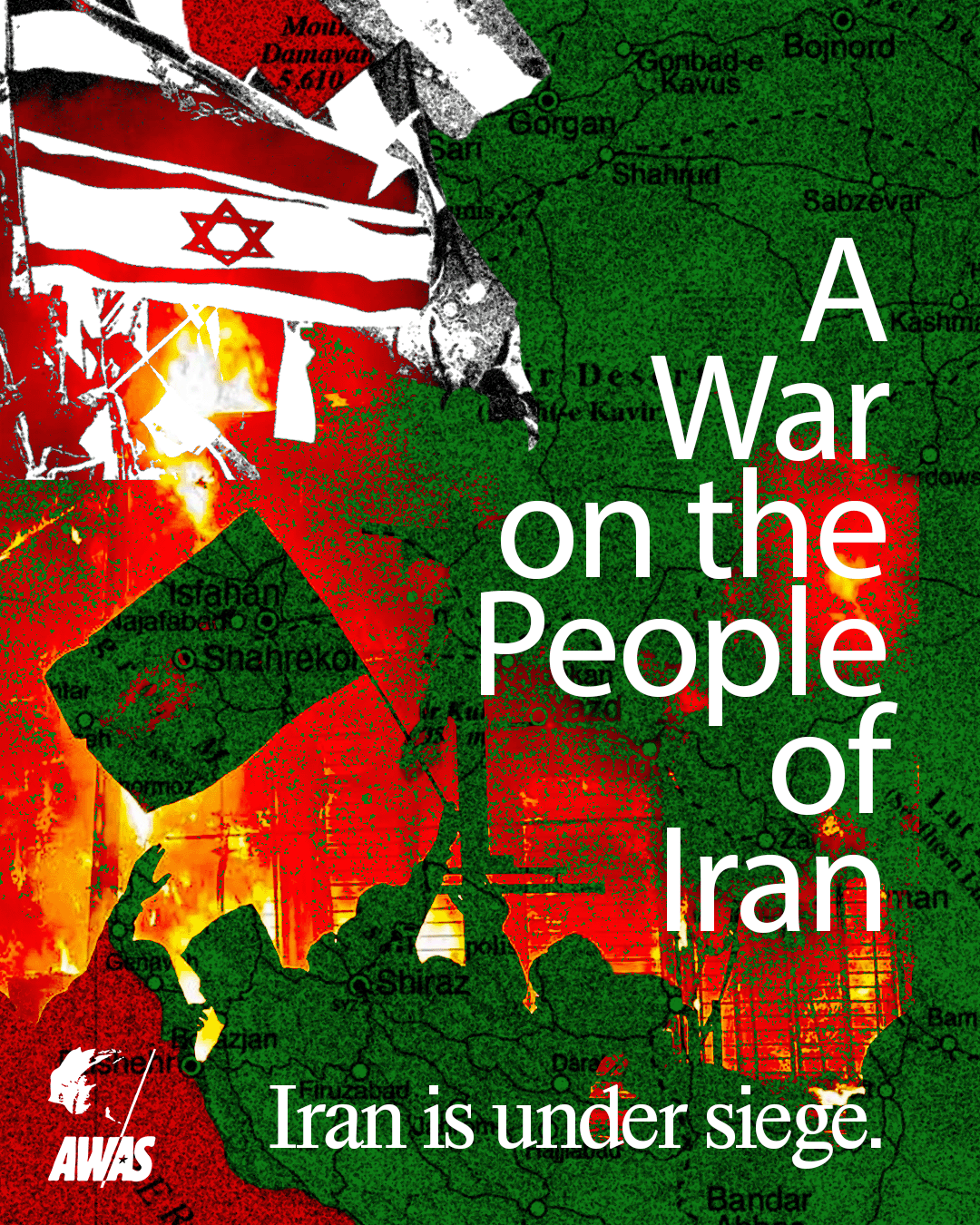
A war is being waged on the people of Iran. Externally through sanctions, economic siege and militarization, and internally through austerity, corruption, and neoliberal capitalism. Alongside this war has emerged a reactionary political formation that claims to speak for Iranian suffering while arguing for the bombing of Iran by Western forces. This is the rise of a new form of Iranian fascism, and its primary terrain of operation is not Iran itself, but the imperial core.
As Mao Says, Communism Means It Is Right to Rebel
The recent protests inside Iran were not merely over economic immiseration—they expressed a structural crisis. From the fuel price uprisings of 2019 to the 2023 protests following the death of Mahsa Amini, repeated violent crackdowns progressively widened the social forces rallying in opposition to the government. These recent rounds brought many poor and working-class communities to the streets; in the recent protests, according to the government’s own documents, the bodies from the morgues were mostly working-class and poor people. Years of unrest have produced limited concessions, but nothing close to what is needed to repair the rupture between the Islamic Republic and Iranian society. Without systemic transformations, the Islamic Republic has neither hope for, nor the right to, longevity. Nonetheless, popular struggle as a social force must be distinguished from the political projects that seek to appropriate it.
The Fundamental Contradiction of the Islamic Republic
The Islamic Republic contains a central contradiction: it has articulated an anti-imperialist, anti-Western posture while remaining economically wedded to the project of Western capitalism, with a liberal technocratic class that brought about the structural reforms that sparked the protests. In Khomeinism: Essays on the Islamic Republic (1993), Ervand Abrahamian identifies parallels between Latin American liberation theology and the Islamic Republic’s founding ideology.1 However, despite emerging from a revolution against U.S. imperialism and formulating an “Islamic Economics,” the architects of Iran’s economy remained committed to neoclassical economics.
What Iranian Fascism Is Today
Iranian fascism takes the form of a new Pahlavism, uniting the comprador bourgeoisie seeking profit through normalization with the West and segments of the national bourgeoisie seeking to privatize state power. This formation is openly pro-U.S., pro-Israel, and anti-communist, but most critically, they are hostile to the legacy of the 1979 Iranian Revolution.The most coherent expression of this reactionary politics is produced not in Iran, but in the diaspora. In Canada and the U.S., large segments of the Iranian diaspora are marching with the Israeli flag chanting slogans like “Death to the three corrupters: the Mullahs, Leftist and the MEK.” They are weaponizing Iranian suffering to defend imperialism.
On Practice
The ideals of the 1979 Revolution were independence, freedom, and social justice—a rallying cry that had unified different opposition groups, creating immediate solidarity with revolutionary and progressive forces globally. The revolutionary spirit of 1979 was akin to the fight for the liberation of the people of Palestine, Vietnam, and Latin America—a people armed and now joining the front against Western imperialism.
Today, the newly politicized Iranians are seen attacking Palestinians at UCLA confrontations,2 and attacking Kurds and other minorities in opposition rallies, rehabilitating former SAVAK torturers, like Sabeti, as political heroes.3 These are not isolated incidents but a consistent pattern of reactionary alignment. Their enemy list is clear: leftists, anti-imperialists, and especially anyone who defends the revolution of 1979. They stand against the newly emerging socialist movements in the imperial core—particularly those that have rallied for Palestinian liberation, and now against anyone who rejects imperialist intervention in Iran.
Why Fascism
Fascism is a politics of myth—that myth is used as a warrant for power. It replaces politics with a story about a pure past, then calls that past our only future. It allows only one kind of break in ordinary politics: intervention by the powerful white, Western imperialists, embodied today in the armada of the U.S. threatening Iran in the Arabian Sea. This fascism disavows the events of 1979, as if the revolution never happened, and as if its aspirations should simply be disowned. This erasure did not begin outside the country. Factions within the Islamic Republic of Iran have long worked to neutralize the revolution’s legacy, and that tendency now sets the tone of Iran’s political economy.
However compromised 1979 became, it still stands in a lineage reaching back to the Constitutional Revolution. Without repose, we must see the new shahist flags as what they are: a myth that the Constitutional Revolution, Oil Nationalization, and the 1979 Revolution are the actions of a people who don’t deserve the dignity of making their own history. They must instead be rightly guided by an Edmund Ironside, by the CIA in 1953, and by SAVAK under Mohammad Reza Pahlavi. A revolution must transcend the class content of its former society, not regress into a mythic construction of the past.
Sanctions as the Material Force of Imperialism
Sanctions on Iran were never about supporting the Iranian people. They were imposed immediately after the 1979 Revolution, briefly eased under the Joint Comprehensive Plan of Action, only to be reimposed when Trump withdrew in 2018. These sanctions are designed not just to weaken Iran’s economy, but also to immiserate the population with the hope of turning Iranian society against the state. Under no conditions do these sanctions help civil society in Iran; in fact, they shrink the middle class. The removal of sanctions is therefore a material precondition for Iran’s social and economic development.
Many of the rising Iranian fascists take on a post-colonial discourse and call Russia and China, and even Iran, imperialist forces in the Middle East. China and Russia have no military bases in Iran, and have not overthrown any government in Iran. China and Russia are Iran’s trading partner, not because Iran is their protectorate, but because Iran is under U.S. sanctions. The Iranian ruling class would love to jettison the Russian and Chinese partnerships for the West. For many Western ideologues, it is impossible to imagine Iran freely trading with other countries without being under the yoke of another nation.
The Political Line
The Iranian people have the right to transform the Islamic Republic or cast it aside entirely. That right naturally belongs to the people living inside Iran. This is a war on the people of Iran. This is not an inter-imperialist rivalry, but an imperialist assault on Iran. Washington and Tel Aviv are not concerned with the living conditions of the Iranian people—they sanctioned them to increase their hardships, wanting a weakened and fragmented Iran that is permanently subordinated to imperial powers.
Once again, Iran is being fooled by U.S. calls to negotiate. And the Iranian Liberal establishment is a more than willing party to the charade. However, our duties in the imperial core remain elsewhere.
What Is to Be Done
Anti-imperialists in the West must call to:
1. End all economic warfare against Iran. This means re-establishing diplomatic relations, reopening embassies, and removing any sanctions on Iran.
2. Fight against the newly emerging Iranian fascists, who are slowly becoming the shocktroops of the right against the rising forces of socialism in the West.
3. Defend the people’s right to struggle against their own ruling classes, and reclaim the revolutionary spirit born in the Constitutional Revolution, carried through Oil Nationalization, and ruptured in 1979.
Sources
1. Abrahamian, Ervand. Khomeinism: Essays on the Islamic Republic. University of California, 1993. http://ark.cdlib.org/ark:/13030/ft6c6006wp/.
2. See this blog post that covered the entire interaction at UCLA, including the names of Iranians who took part in the assault on the encampment: Bezan, Lailah. “Timeline: UCLA Students and Faculty Seek Justice After Zionist Mob Attack on Spring Encampment.” Institute for Palestine Studies (blog). December 20, 2024.
https://www.palestine-studies.org/en/node/1656625#:~:text=A%20pro%2DPalestine%20demonstrator%20(Bottom,the%20night%20of%20the%20attack.
Also see this video of Iranians harassing Palestinian activists at UCLA: https://x.com/PplsCityCouncil/status/1783684176010723419.
3. See image here: https://x.com/GEsfandiari/status/1624838483754745856.
4. This article argues for a balkanized Iran, that came out amid the recent protests in Iran: Kaylan, Melik. “A Fractured Iran Might Not Be So Bad.” Wall Street Journal, January 16, 2026.https://www.wsj.com/opinion/a-fractured-iran-might-not-be-so-bad-5ec2d702.